
Running a Local Mining Meetup: Turning It Into an Ambassador Role
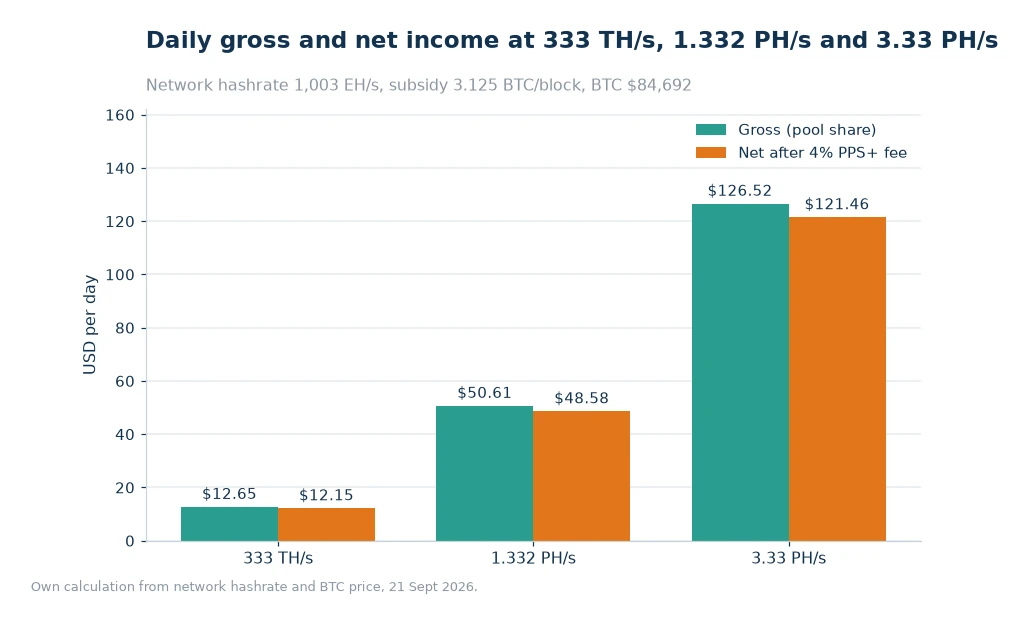
A mining meetup is cheaper to run than most people expect and harder to keep alive than most organizers admit. Ten regulars with one 333 TH/s machine each control 3.33 PH/s and earn 0.00149386 BTC a day between them, which is $121.46 net at $84,692 per coin. That single calculation, done out loud in front of the room, does more to hold a group together than any announcement.
Key takeaways
- One 333 TH/s machine credits 0.00014939 BTC a day, or $12.15 after the listed 4%.
- Ten such machines reach 3.33 PH/s and $121.46 a day net, which is a realistic club scale.
- A four-item agenda beats a guest speaker: accounts, payouts, power, hardware.
- Regulars who keep coming back are the natural candidates for Apply for Ambassador.
Why a room beats a group chat
Chat groups are good at quick answers and terrible at building understanding, because the person who asks a basic question at 2 a.m. gets three conflicting replies and no context. A room imposes order: one question, one explanation, one worked example on a screen. People who have watched the arithmetic happen once tend to remember it, and they stop repeating myths they picked up elsewhere.
There is also a social function that no support desk can replace. Mining is solitary work, and an operator with a noisy container and a flat month needs to hear that other people had the same month. A meetup where two members compare power bills is doing useful work even if no slide is shown.
An agenda that fits ninety minutes
Four items, twenty minutes each, ten for the room. First, accounts and wallets: where the payout address lives and why it is not an email address. Second, payouts: PPS+ against PPLNS, hourly against 6 confirmations, and why a quiet day is not a fault. Third, power: the only cost that decides whether a machine stays plugged in. Fourth, hardware: cooling, noise, and what a failed fan sounds like.
The order matters. Accounts first because nothing else makes sense without one; power last because it is the item most likely to start an argument. Hosts who open with hardware tend to spend the evening on specifications and never reach the numbers that determine whether anyone in the room is making a margin.
Doing the payout arithmetic in public
Put the daily credit on the screen at three scales and let the room check the multiplication. The figures below assume a 333 TH/s unit, current difficulty and a BTC price of $84,692, with the listed 4% already applied in the final column. Nobody has to trust the presenter, because anyone with a phone can reproduce the sum.
| Machines | Total hashrate | BTC per day | Net USD |
|---|---|---|---|
| 1 | 333 TH/s | 0.00014939 | $12.15 |
| 10 | 3.33 PH/s | 0.00149386 | $121.46 |
| 40 | 13.32 PH/s | 0.00597543 | $485.82 |
The middle row is the one to dwell on. Ten members with one machine each do not become a mining company, but they do become a group with a shared interest in understanding settlement. When one of them has a bad week, the group can check whether the cause was difficulty, a pool's luck, or a fan that stopped. That is a support network built out of arithmetic rather than sympathy.
Worked example
Run this in front of the room and let somebody else hold the calculator.
- Network output: 3.125 BTC × 144 blocks = 450 BTC a day.
- Output per TH/s: 450 ÷ 1,003,107,267 = 0.000000448606 BTC.
- At 333 TH/s: 333 × 0.000000448606 = 0.00014939 BTC.
- At $84,692: 0.00014939 × 84,692 = $12.65.
- After the listed 4% on the block-reward component: 12.65 × 0.96 = $12.15.
- Ten machines: 10 × 0.00014939 = 0.00149386 BTC, or $121.46 net.
- Power at 22 J/TH and $0.05/kWh: 333 × 22 = 7,326 W, × 24 = 175.8 kWh, × 0.05 = $8.79, leaving $3.36.
That last line usually changes the mood in the room. The gross figure looks comfortable, the net figure looks fine, and the margin after power is thin enough that a fan failure or a difficult month erases it. Better to have that conversation at a meetup than to discover it alone at the end of a quarter.
From regulars to a role
After four or five meetings a pattern appears: two or three people answer the newcomers before you do. Those are the candidates. An ambassador role is mostly that behavior with a structure around it, and the ViaBTC Ambassador Program is where the structure lives. Read the terms together rather than alone, because the obligations concern the group as much as the individual.
Apply for Ambassador once there is something to point at: a recurring meetup, a written FAQ, a chat where questions get answered in the local language. An application that describes a real room is more persuasive than one that describes an audience in the abstract. It also sets a healthier expectation, since the role will be judged on the same room six months later.
Tools that keep the room moving
Two pages cover most of what a meetup needs. The pool's Statistics view shows pool hashrate and network hashrate side by side, which is the quickest way to explain why an individual machine's share moves without anything being wrong with it. The ViaBTC App, on iOS and Android, lets each member watch their own hashrate and set an alert, so the next meeting starts with data rather than recollection.
Keep the venue boring. A room above a cafe with a projector, a power strip and decent wifi costs little and does not intimidate a first-timer. Rotating between members' sites sounds appealing until the third meeting is two hours away and half the group does not come. Consistency beats spectacle when the goal is a habit.
Money, noise and neighbors
The questions that end meetups are rarely about hashrate. They are about a landlord who noticed the electricity bill, a neighbor who can hear a fan through a wall, and a partner who wants to know when the hardware pays for itself. An ambassador who has thought about those three will keep members longer than one who can only discuss ASIC models.
Practical answers help: acoustic foam and a solid door do more than a quieter firmware setting, a written agreement with a landlord is worth more than a verbal one, and a simple payback calculation at the current price is a better answer than a forecast. None of that is mining mathematics, and all of it is why people stay in the room.
Frequently asked questions
How many people do I need before starting a meetup?
Six is enough. Ten machines at 333 TH/s each already represent 3.33 PH/s and $121.46 a day net, so a small room has plenty of real arithmetic to work through.
What should the first session cover?
Accounts and wallets first, then how PPS+ settles hourly against PPLNS and its 6-confirmation wait, then power cost, because margin rather than gross output decides whether a machine stays online.
Is a meetup required to join the ambassador program?
No, but a recurring room with a written FAQ is concrete evidence of reach, which is what an application needs to describe rather than a follower count.
Book the second meeting before the first ends
The failure mode of every club is a good first evening and no date for the next one. Set it in the room, write it in the chat, and give somebody a job: one person on accounts, one on payouts, one on the projector. Small responsibilities turn attendees into organizers, and organizers are what an ambassador role is made of.
Then keep the arithmetic visible. A printed sheet with the daily credit at the hashrates people actually own, updated when difficulty moves, is the most useful object at any meetup. It answers the question everyone is too polite to ask directly, and it does so without a sales pitch attached.
Sources: the ViaBTC ambassador, statistics and app pages for program scope and pool data[1]. Chain data read 21 Sept 2026: network hashrate 1,003 EH/s, difficulty 132.76 T, 3.125 BTC per block, 144 blocks a day, BTC $84,692. Published 22 Oct 2026; power costs are illustrative.